Beschrijving
See also: Sotheby's, London, April 6, 2011, lot 411, for a set of eight featuring Ottoman figures. (link)
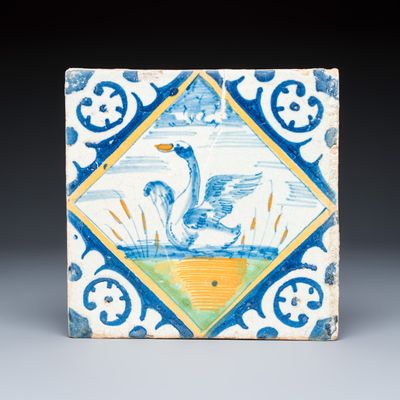
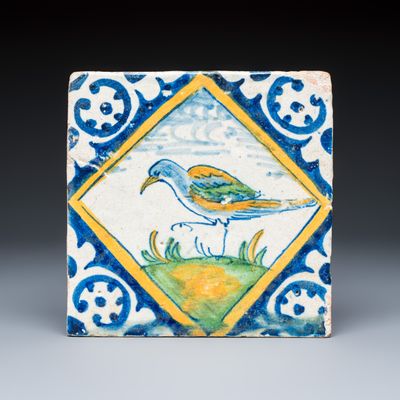
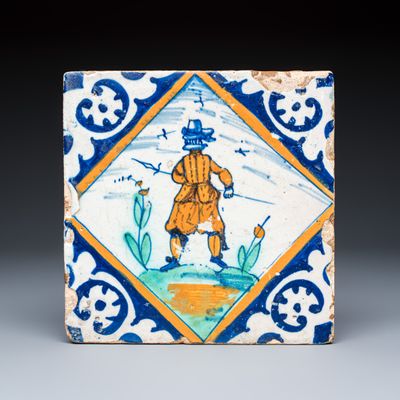
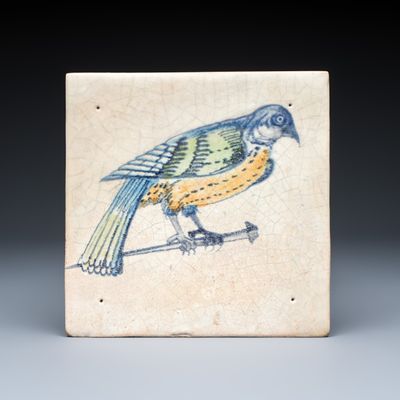
Between 1880-1900 the tile factory of Ravesteijn in Utrecht produced two series of tiles depicting animals and Turkish men and women for export to Britain. The six-inch format (15 x 15 cm) made them suitable for use in surrounds of cast-iron grates for hearths and other items of furniture.
Although these tiles are not found in extant Ravesteijn catalogues, sponsen (pricked stencils) from the Ravesteijn factory with designs for both series have been preserved in the Tichelaar archives in Makkum in the province of Friesland.
The tiles in question can also be found in a tile catalogue of circa 1890 issued by the cast-iron grate manufacturer Thomas Elsley in London, who imported Dutch tiles for use in his fireplaces. The Elsley catalogue shows two tiles with Turkish women under design no. 30 and one animal (lioness) tile under design no. 48.
The animal series is based on print sources such as J. Jonston's Historia Naturalis published in Frankfurt in 1650. It consists of two types of animals: European animals such as the horse, cow, bull, cat, deer (four different types) and sheep, and also exotic animals such as the panther, lion, elephant and rhinoceros. To date 19 different animals have been recorded and it is conceivable that the whole series consisted of perhaps 20 to 24 designs.
The series with Turkish men and women is less well known and surviving examples are rare. This series is based on the prints in Nicolas de Nicolay's Les Quatre Premiers Livres des navigations pérégrinations orientales, published in Lyons in 1568. In 1576 a Flemish edition was published by Willem Silvius in Antwerp under the title De Schipvaert ende Reysen gedaen int Landt van Turckyen deur N. de Nicolay. The series shows men and women in 16th-century Turkish costumes indicating their profession and status.
The fact that examples of both series are found mainly in Britain may have something to do with the Aesthetic Movement, which had a strong interest in Oriental design as well as blue-and-white porcelain, while William Morris fostered a liking for hand-made and hand-decorated objects. Hand-painted blue-and-white Dutch tiles with exotic themes were ideally suited to these British design fashions.
(Text: Hans van Lemmen - Tegel 25, 1997 - Yearbook of the Dutch tile museum) (link)
A rare large blue and white Dutch Delft tile with a leopard, Ravesteijn
Utrecht, 19th C.
Dim.: ca. 15 x 15 x 1 cm
Schatting
€ 200 – € 400